How to Improve Gas Mileage
How to Improve Gas Mileage: What a Fuel System Tune-Up Actually Does
⚡ QUICK ANSWER The fastest way to improve gas mileage is to restore your fuel system to peak efficiency with a decarbonization service, fuel filter replacement, and air filter service. This can improve fuel economy by 4–40% depending on how overdue the service is. Wayside Garage in Seaside, CA recommends this every 10,000 miles or 12 months.
Right now, filling up your gas tank feels like a punch to the wallet. Whether you're commuting up Del Monte Boulevard every morning or making a weekend run over to Big Sur, you're probably watching that dollar amount climb at the pump and wondering: is there anything I can actually do about this?
The answer is yes — and it's simpler than you think. A poorly maintained fuel system is one of the most common and most overlooked reasons cars burn more gas than they should. The good news is that it's completely fixable.
Why Is My Car Getting Worse Gas Mileage?
Your engine is remarkably precise. It needs exactly the right mix of fuel and air, delivered at exactly the right moment, to run efficiently. When any part of that system gets dirty or worn out, your engine compensates by burning more fuel to produce the same power. And that compensation happens quietly — no warning light, no obvious symptom — just a gas tank that seems to empty a little faster every month.
Here are the most common culprits:
- Dirty fuel injectors — These spray a fine mist of fuel into the combustion chamber. When carbon deposits build up on the nozzle, that mist becomes uneven. Too much fuel in some cylinders, not enough in others. Wasted gas, every cycle.
- Carbon deposits in the intake system — Over time, carbon coats your intake valves and combustion chamber walls, reducing airflow and choking engine efficiency. Your engine works harder to breathe, and you pay for it at the pump.
- Worn spark plugs — When spark plugs start to fail, they misfire. Misfires mean fuel entering the combustion chamber that never actually burns. That fuel goes out the exhaust as waste — and you paid for it.
- Clogged engine air filter — Your engine mixes roughly 14 parts air to 1 part fuel. Restrict the airflow with a dirty filter and that ratio goes off, forcing your engine to run rich and burn more gas than it needs.
- Old fuel filter — The fuel filter keeps debris and contaminants out of your injectors and fuel pump. A clogged filter reduces fuel pressure, causes hesitation, and makes your fuel pump work overtime. It wears out your fuel system and burns more gas in the process.
- Faulty oxygen sensors — Your O2 sensors are the feedback loop between your exhaust and your engine's computer. A failing sensor sends bad data, and your engine responds by injecting more fuel than necessary. You'll never feel it — but you'll absolutely pay for it.
What Does a Fuel System Tune-Up Actually Include?
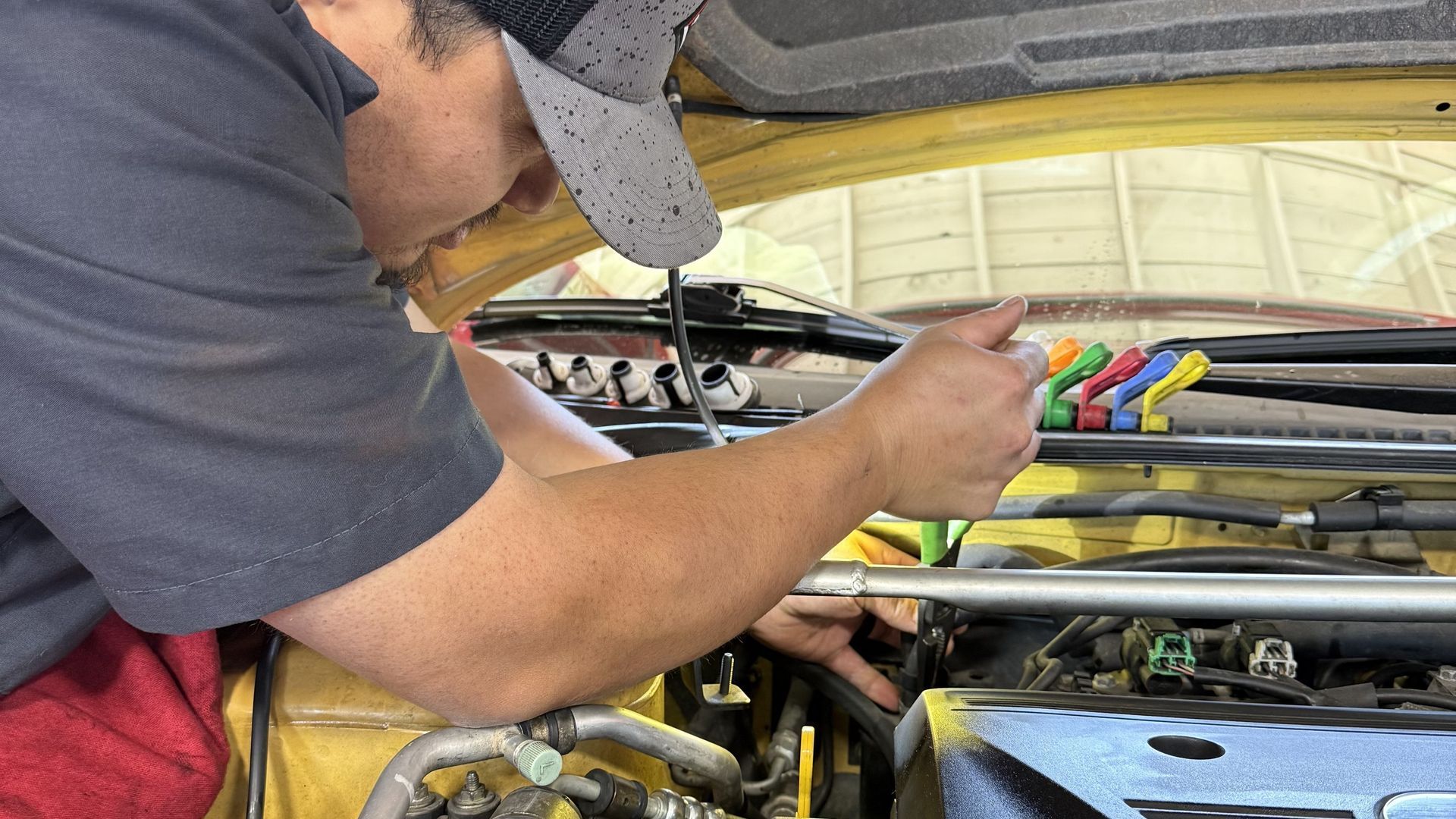
At Wayside Garage, our Fuel & Air System Decarbonization/Tune-Up is a comprehensive service that targets every component that affects how cleanly and efficiently your engine burns fuel. Here's exactly what we address:
- Fuel & air system decarbonization — A specialized cleaning process that removes built-up carbon from intake valves, injectors, and the combustion chamber. Think of it as a deep clean for the inside of your engine.
- Fuel filter replacement — Fresh fuel filter to restore full fuel flow and protect your injectors and pump. Recommended at every 20,000 miles or 24 months.
- Engine air filter inspection and replacement — Ensures proper air-to-fuel ratio for clean, efficient combustion.
- Oxygen sensor inspection — We check your O2 sensors to confirm your engine is getting accurate fuel feedback.
- Spark plug inspection — At 60,000 miles or 60 months, spark plugs are due for replacement. We'll let you know exactly where you stand.
The result isn't just better mileage. You'll also notice smoother acceleration, cleaner idle, and an engine that just feels more responsive.
How Much Can a Tune-Up Actually Save Me?
This is the question that matters most. And the numbers are real.
Research consistently shows that a neglected fuel system can reduce fuel economy by 4% to 40% depending on how many components are overdue. At current Monterey-area gas prices, let's put that in actual dollars:
- If your car averages 28 mpg and you drive 12,000 miles per year, you buy roughly 429 gallons of gas annually.
- A 10% improvement in fuel economy means you'd buy about 39 fewer gallons per year.
- At $5.50 per gallon (current local average), that's over $200 back in your pocket — from a single tune-up.
And that doesn't account for the longer-term savings from protecting your fuel pump, injectors, and catalytic converter from damage caused by a dirty, inefficient fuel system.
When Should I Get This Service Done?
According to Wayside Garage's maintenance plan, a Fuel & Air System Decarbonization/Tune-Up is recommended at every 10,000 miles or 12 months — whichever comes first. The fuel filter specifically is due at 20,000 miles or 24 months.
If you can't remember the last time either of these was done, that's your sign. Bring it in and we'll do a quick inspection to tell you exactly where you stand — no charge, no pressure.
Does This Apply to My Hybrid Too?
Absolutely. Hybrids still use a combustion engine and are just as susceptible to carbon buildup and fuel inefficiency as traditional vehicles — sometimes more so, because the gas engine runs in short bursts that don't always fully warm up the system. At Wayside Garage, we're fully equipped to service hybrid vehicles including Prius, RAV4 Hybrid, Camry Hybrid, and others common in the Monterey area.
Frequently Asked Questions
Can a tune-up really improve my gas mileage? Yes — especially if your vehicle is overdue for fuel system service. The improvement varies by vehicle and how neglected the system has become, but most drivers notice a meaningful difference in fuel economy and engine smoothness.
How long does a fuel system tune-up take? Most fuel system services at Wayside Garage take 1–2 hours. We always call before starting any additional work so there are no surprises.
What if my car has no warning lights — do I still need this? Yes. Fuel system degradation typically happens gradually and silently. By the time you notice a symptom, the issue has usually been costing you money for months.
Ready to stop burning money at the pump? Schedule your fuel system inspection at Wayside Garage today. We'll tell you exactly what your car needs — honestly and clearly, with no pressure and no surprises. Call us, stop by our shop in Seaside, or book online at waysidegarage.com. Your wallet will notice the difference.