Check Engine Light On?
Check Engine Light On? Here's What It Means and What to Do Next
⚡ QUICK ANSWER A steady check engine light means your car's computer has detected a problem that needs attention — but it is rarely an emergency. A flashing check engine light is more urgent and should be addressed immediately. The most important step is an accurate diagnostic, not just reading a trouble code. At Wayside Garage in Seaside, CA, we specialize in advanced diagnostics including live data analysis, component testing, and difficult-to-diagnose problems other shops have missed.
There it is. That small amber light on your dashboard, glowing quietly like it has something important to say.
Your stomach does a small drop. You start running through scenarios. Is it serious? Can I make it to work? How bad is the bill going to be? Can I just... ignore it for a little while longer?
The check engine light is probably the most emotionally loaded indicator in a modern car — partly because it can mean so many different things, and partly because too many drivers have been burned by shops that charged them for a repair that didn't fix the problem.
Let's clear up exactly what's happening, what you should do, and how to make sure you get it diagnosed right the first time.
What Is Your Check Engine Light Actually Telling You?
Your car has an onboard computer system — called OBD-II — that monitors hundreds of operating parameters in real time: fuel delivery, ignition timing, oxygen levels in the exhaust, transmission behavior, emission system function, and much more.
When a sensor reading falls outside the acceptable range, the system stores a diagnostic trouble code (DTC) and turns on the check engine light. The code is basically the computer's way of flagging: something here is outside of normal.
Here is the critical thing most people — and many shops — get wrong:
The code is not a diagnosis. It is a starting point.
Code P0420 (Catalyst System Efficiency Below Threshold) is frequently misdiagnosed as a bad catalytic converter. Replace it, spend $900–$1,400, drive away — and the light comes back on three weeks later. Why? Because the real cause was a failing oxygen sensor ($150–$250) or a small exhaust leak that was causing false readings. The code pointed toward the catalyst. The actual problem was upstream of it.
That is what real diagnostic work is designed to find.
Why 'Free Code Reading' Is Just the First Step
You've seen the signs at parts stores: "Free Check Engine Light Diagnosis!" They plug in a handheld reader, pull the code, tell you what part to buy. Sometimes that's all it takes. But that approach fails on a significant percentage of check engine issues — especially intermittent faults, multiple concurrent codes, and anything involving sensor data that only shows up under specific driving conditions.
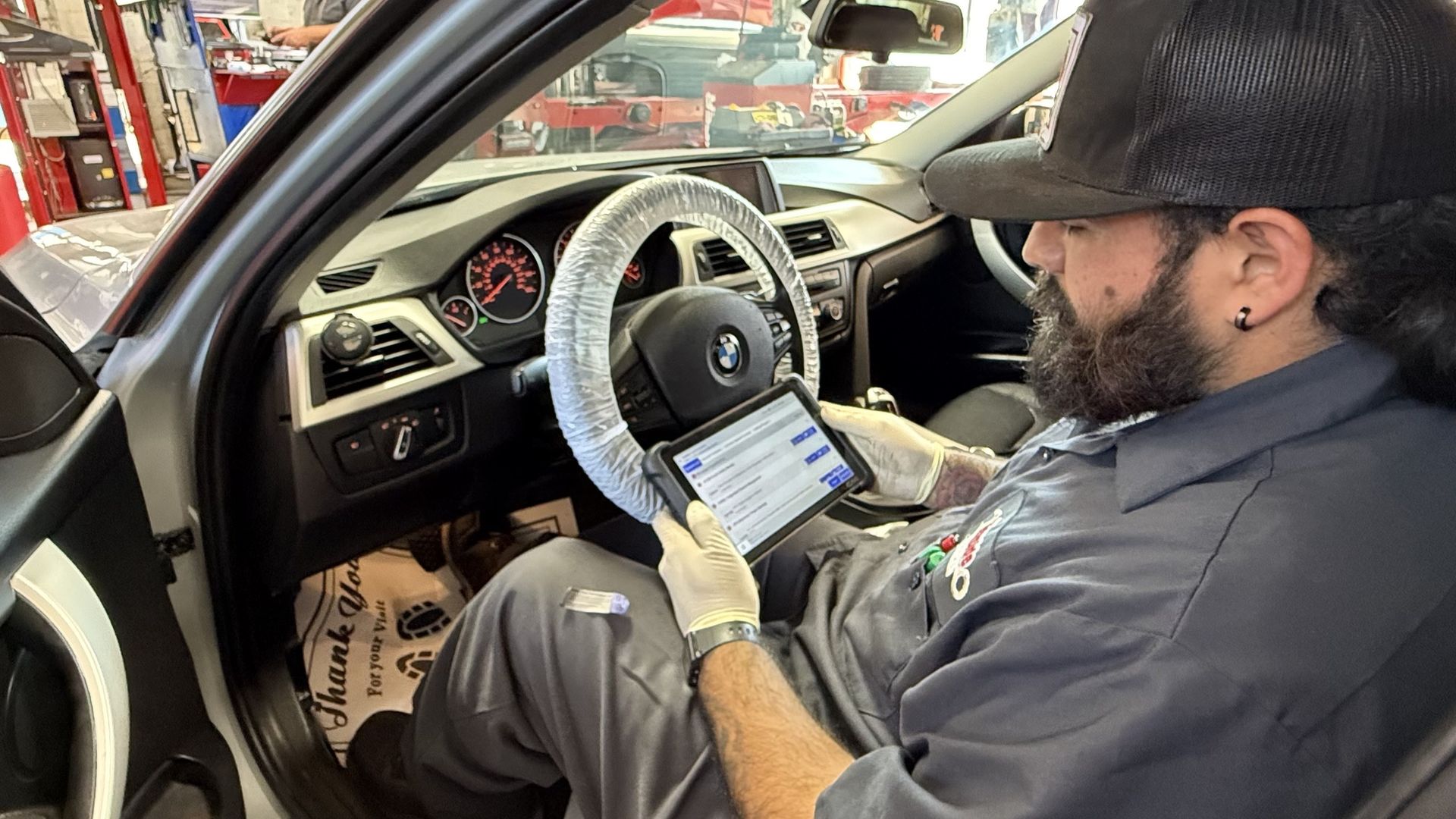
A thorough diagnostic at Wayside Garage goes considerably deeper:
- Live data streaming — We monitor real-time sensor readings while the engine is running, watching oxygen levels, fuel trims, ignition timing, and airflow interact with each other. This shows us what is actually happening, not just what was flagged.
- Freeze frame analysis — We examine the exact operating conditions — speed, load, temperature, RPM — present at the precise moment the fault was triggered. This context changes everything.
- Component-level testing — We physically test sensors, actuators, and connectors rather than assuming the flagged component is the failed one.
- Technical Service Bulletin (TSB) review — Manufacturers regularly issue documented known issues for specific vehicles. We cross-reference your year, make, and model against current TSBs — a step many shops skip entirely.
- Wiring and connector inspection — A striking percentage of 'difficult' check engine problems turn out to be corrosion on a connector, a pinched wire, or a failing ground. These faults don't always show up on a scanner — they require eyes on the car.
When Other Shops Can't Figure It Out — Come to Us
We hear this story regularly: "I took it to two other places. One replaced a sensor, one cleared the code and sent me home. The light came back on both times."
Intermittent faults are particularly difficult. A check engine light that only appears in cold weather, or only after highway driving, or only under heavy load — these require patience, experience, and diagnostic equipment capable of capturing data under exactly the right conditions.
Our technicians have decades of combined diagnostic experience across all makes and models: domestic vehicles, European imports, Japanese imports, hybrids, and EVs. We invest in continuous training and advanced equipment because we believe every customer deserves a real answer — not a parts-swap guess that might work.
We will not clear your code and send you on your way. We will find out why the light came on, explain it to you in plain language, show you what we found, and give you honest options. If the repair is not urgent, we will tell you that too.
Common Check Engine Light Causes
- Loose or faulty gas cap — Check this first. It sounds too simple, but a loose cap accounts for a surprising number of check engine lights.
- Oxygen sensor failure — Affects fuel delivery and over time damages the catalytic converter if left unaddressed
- Catalytic converter degradation — Often secondary to another issue; accurate diagnosis matters here
- Mass airflow sensor problems — Directly affects fuel metering and engine performance
- Spark plug or ignition coil failure — Can cause misfires, rough idle, and reduced power
- EVAP system leak — Emission-related; often caused by fuel cap, hoses, or purge valve
- Transmission-related codes — Range from minor sensor faults to fluid degradation
- EGR valve issues — Can affect idle quality, performance, and emissions
Steady Light vs. Flashing Light — What's the Difference?
This distinction matters.
- Steady check engine light — Indicates a fault that needs attention but is generally not an immediate emergency. Drive normally, but schedule a diagnostic soon. Ignoring it long-term can allow small problems to become expensive ones.
- Flashing or blinking check engine light — This signals an active engine misfire serious enough to damage the catalytic converter. Pull over safely when possible and call us. Continuing to drive with a flashing light can turn a manageable repair into a significant one.
Frequently Asked Questions
Can I keep driving with the check engine light on? If the light is steady and the car feels normal, you can typically drive short distances. Schedule a diagnostic soon. If the light is flashing, or if you notice rough running, loss of power, or unusual smells, pull over and call us.
How much does a check engine light diagnostic cost? Diagnostic fees vary based on the complexity of the fault. What we can promise is that our diagnosis is thorough, our findings are explained clearly, and we will never recommend a repair we can't justify. We discuss costs upfront — no surprises.
Why did the light come back on after another shop fixed it? Most likely the code was read but not diagnosed — meaning the flagged component was replaced without confirming it was the actual root cause. Our process is designed specifically to prevent this.
Your check engine light came on for a reason. Let Wayside Garage find out what that reason is — accurately, honestly, and the first time. Schedule your diagnostic appointment online at waysidegarage.com, give us a call, or stop by our shop in Seaside. We have been solving the tough cases on the Monterey Peninsula for years, and we are ready to solve yours.